I write now, a few days after the repose of Archdeacon Professor Ioan Caraza (d. 31 July 2025), and I realise that his mark upon me as a young man was profoundly formative, at a time when Romania experienced turmoil in the late 80s and the early 90s. I write and I am taken by surprise at this realisation—while the memory of those days and my encounters with him, until recently lost within the innermost corners of my subconscious, erupt, come to light, and prevent me from pushing it back, into the haze of oblivion.
My first encounters with the venerable Father occurred from a distance, without personal contact. At the time, I was a student of Radu Vodă Theological Seminary, in Bucharest, towards the end of the 80s. I remember that, at the request of Archimandrite Grigore Băbuș—who was for many years the director of the library of the Holy Synod, at the All Saints “Antim” Monastery—together with a few other colleagues who did not leave the city during the summer holidays, I was helping with the (forced) reorganisation of the library. The shadows of ruin that plunged Bucharest into the depths of so much sorrow during Ceaușescu’s dictatorship reached Antim Monastery. Specifically, the library had to be relocated to a smaller space, so much so that many books had to be thrown out. There was a mound of torn books in the courtyard of the monastery, right in front of the church… I do not recall the explanation I received about the pile of torn books. It is likely that these were surplus copies, which could not be stored in the new, smaller space of the library. I do not remember who had thrown them there, but Father Băbuș encouraged us, students, to look around and to see which ones could be saved from destruction. He even allowed us to take back home the books we liked. This was the beginning of my personal theological library, which, when I left Romania, in 2004, counted several thousand copies. What matters within this context is that there, at Antim Monastery, I experienced something remarkable.
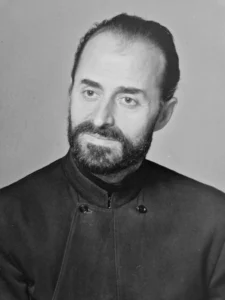
The Very Revd Archdeacon Professor Ioan Caraza
It is there and then that I noticed the silent presence of Father Caraza, whom I saw almost everyday during the time I spent in the monastery’s courtyard. He was coming in and going out, sometimes stopping to pick a book from the mound of desolation. I had no idea who he was, dressed as he was in his usual civilian black suit and shirt, but there was something about his slender look and a little hunched stance, a serenity the source of which could not have been the here and the now. I don’t remember him to have interacted with me and my colleagues, but I remember his presence among us—there, at Antim, during those days of sorrow, when dreams of pharaonic building projects led to the destruction of Bucharest’s historic centre, together with many lives and many books…
I saw Father Caraza again after a few years, when I became an undergraduate student of theology, in 1989. Of course, he was a faculty member… My first personal contacts with him took place during those years of confusion that followed the end of the dictatorship, years when most students happily and irresponsibly missed lectures and seminaries because they could do so… This would have been unconceivable before 1990, when attendance was compulsory. Chaos replaced the previous order. I cannot claim to have behaved better than most students. I was not prepared to manage my freedom better than others. But, at least, I tried to attend as many lectures I could, especially of The Very Reverend Professor Dumitru Popescu and Professor Remus Rus, as well as the seminaries led by two assistant lecturers, Fathers Ion Chivu and Constantin Coman, whose freedom in Christ and erudition impressed me. In turn, the unobtrusive humility of Father Caraza, his invisibility, so to speak—at the time, he was an assistant lecturer of catechetics, if memory serves—intrigued me as before but did not stir my enthusiasm. I don’t even recall to have attended any of his seminaries before the moment that makes for the object of this evocation, which I relate in what follows.
It was undoubtedly the divine providence that ordered things in such a way, that once, for reasons I don’t recall, I was aimlessly roaming the halls of the school. It must have been in ’91 or ’92. And so, I passed by a seminar room of which the door was open and where Father Caraza was sitting at the desk by himself, reading. I asked for permission to enter and he was happy to have me take a seat. This was the first and the only occasion I have ever had to be in his immediate presence without anyone else in sight. I don’t remember to have had the occasion of saying more than a few words during that seminar, against my custom. I am certain that many of my colleagues remember me as an outspoken questioner of many assertions of our professors, lecturers, and tutors—one who loved debating fiercely with and contradicting everyone; one full of arrogant dare, equipped with a good mind but possessed of little wisdom. From the temporal distance of the man of today, I was a seeker of truth. But that seminar with Father Caraza was not of your run-of-the-mill variety, where a lecturer or tutor impressed the students either by erudition or intelligence or rhetorical quality—or by fabricated, ostentatious “spirituality.” No. That seminar amounted to a contemplative spiral of intense complexity, focusing on the similarities and the differences between the related passages of Matthew 7 and Luke 6, specifically, the parable of the house built on a solid foundation.
I do not recall what prompted this discussion. It might be that he offered me the opportunity to ask or discuss something and most likely I did not think of anything, not actually knowing him. And so, in the absence of any contribution on my part he must have turned to a topic that was dear to him. Much later, when I began to study Saint Maximus’ works, I realised that that seminar was a lesson of patristic exegesis in vivo, a mystagogic lesson. I must confess that I haven’t experienced anything of this kind within academia. But what matters is that in time I came to realise that the Father’s monologic discourse—for I had not much to contribute, apart from some affirmative grunts, to his many rhetoric interrogations, “see, Mr student?”—referred to the nature of the theological method. And even though I do not recall the exact content of his exegesis, beyond the recurrent point about digging deep to lay the foundations of one’s “home,” I was impressed by the analytical manner and the depth of his perception of things.
His discourse was indeed exegetical, but not in the vulgar sense of counting the bricks of Jericho’s walls, nor in the equally vulgar sense of “spiritual” digressions for broad consumption. What I was able to grasp from that seminar is that for him the scope of exegesis was to sketch a method of theological research able to transcend both the syntheses of systematic theology, as well as of the history and phenomenology of ideas, by way of a deliberate dive into the mystery of the Word and its nuances, its existential resonance. The method of the Father, I found with great surprise, was typical for lateral thinking. It abandoned the usual linear or demonstrative trajectory, instead searching for the meaning of the text in unexpected directions, towards horizons I haven’t encountered before in that form. These horizons affirmed the significance of the person in ways that—surprisingly, I must say once more—were compatible with the revolutionary manifesto—for I was reborn in December 1989 and, again and again, in the ensuing years—to which I adhered and which I have never betrayed in my life, but which then had, in my mind, only superficial contours. I rediscovered the form of his exegesis many years later, when I turned from the facility of systematic theology to the study—always challenging in its prophetic subtext—of patristic wisdom.
What matters is that, during that seminar, I was given to discover something about the veiled, humble countenance of the truly free man that the Father himself was, whose freedom in Christ did not depend on temporal landmarks, such as before and after ’89…
The novelty of his approach was evident to me, and the Father’s absorbed manner impressed me deeply, even though a number of years had to pass before I understood that it was a mystagogical foray into the ocean of the Word, a personal plunge in which he had invited me, too, to take part. In retrospect, more than thirty years later, I am convinced that although I have never considered Archdeacon Professor Caraza to be one of my mentors, that astonishing seminar—Wonderland—marked me more decisively than everything I learned during the four years of my undergraduate studies. This belated realisation matches perfectly what I perceived about this quiet, humble man from the very beginning, when I first saw him at Antim. True teachers teach even when the students do not know that wisdom is being bestowed upon them. The true teachers nourish the students without obscuring their horizon with their own presence.
The privilege of having been the sole beneficiary of that exercise in scriptural contemplation changed my life and my thinking in ways of which I became aware only with time. Now, post hoc, I realise that, when I in turn became a university assistant lecturer at the same school, I instinctively tried to adopt his way of working. Some of the students of those years probably still remember my forays into the thought of Saint Maximus, or my repeated contemplation of the resonances of the Eucharist for various aspects of personal and ecclesial life (a contemplation which, at the time, amused some of my mentors and older colleagues). The common denominator of those attempts was the assumption that any facile, literal approach to a sacred text or ritual is counterproductive, that it deceives both the interpreter and the listeners with false certainties. Of course, there was another common denominator, which I had forgotten about, or rather the significance of which I had not yet grasped: That mystagogical seminar with Father Caraza, which set me on a path whose parameters were still unknown to me, but which became, nolens volens, my own path.
Another thing is clear now, after many years, that, from that seminar on, the world of quantities and surfaces ceased to impress me. Whether I worked with many students or few, and sometimes with only one or none, I continued to repeat, often without intending to do so, what I had lived as a student in the presence of Father Ioan Caraza.
Acknowledgment This text represents the author’s translation of his essay, “Un Seminar Mystagogic cu Părintele Caraza,” originally written in Romanian for what was meant to be a festschrift in honour of Archdeacon Professor Ioan Caraza. The volume appears to still be in the making.
18 November 2026 © AIOCS
Please support our not-for-profit ministry (ABN 76649025141)
For donations, please go to https://www.paypal.com/paypalme/aiocsnet or contact us at info@aiocs.net