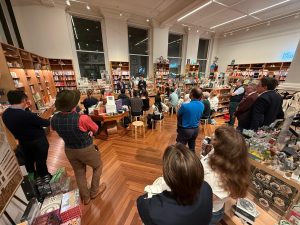
I bring good news: Christ is risen! It’s an honour and indeed a pleasure to be given the opportunity to speak on a topic that is extremely dear to me, The Philokalia, and to launch this new translation of representative parts of it. Warm congratulations to Professor Jonathan Zecher and to Emeritus Professor Archpriest Andrew Louth, two eminent scholars and Orthodox colleagues whose research I admire immensely, and who led this worthy translation project to fruition.
Just for the record, The Philokalia is a collection of spiritual treatises written—mainly in Byzantine Greek—from the fourth to the fifteenth century, in places ranging from Assyria to Egypt to Sinai and Palestine to the Greek islands to continental Greece. More than a thousand years of spiritual literature! The Greek word philokalia means, etymologically, “love of beauty,” where “beauty” denotes—at least within this context—important existential outcomes of the spiritual journey. The word also means “collection,” or anthology, as our translators prefer—in this case, an anthology of treatises exploring the ascetic path leading to one’s beautiful transformation into a noble, gentle human being.
The collection was put together in Mount Athos, in Greece’s northern parts, in the eighteenth century, and was published in Venice, Italy, in 1782, the production expenses being covered by a Greek philanthropist who, incidentally, reigned over one of Romania’s medieval principalities. The editors of The Philokalia, known through traditional channels—since the first release of the massive volume doesn’t even mention them—were a monk, St Nikodemus of the Holy Mountain, and a former diocesan bishop, St Macarius of Corinth. Both were interested in writings that map the spiritual experience known as hesychasm, from the Greek hesychia, tranquility, an experience to which I usually refer as the Byzantine way of serenity. Their interest transpires through the original title of the collection, which runs as follows: Φιλοκαλία τῶν Ἱερῶν Νηπτικῶν συνερανισθεῖσα παρὰ τῶν Ἁγίων καὶ Θεοφόρων Πατέρων ἡμῶν ἐν ᾗ διὰ τῆς κατὰ τὴν πρᾶξιν καὶ θεωρίαν ἠθικῆς φιλοσοφίας ὁ νοῦς καθαίρεται, φωτίζεται καὶ τελειοῦται (“The Philokalia of the holy awakened ones, collected from our saintly God-bearing fathers, whereby the mind achieves purification, enlightenment, and perfection through the praxis and contemplation that pertain to ethical philosophy”). In short, a guide for people who seek awakening and awareness of themselves and reality, by progressing on the path to perfection.
Nevertheless, the readers of the introductory study—where the translators provided much more information than I can afford to share now—will discover, perhaps with surprise, that the Greek quest for compiling The Philokalia was not the only endeavour of this sort in the eighteenth century. It was preceded by the efforts of St Paisy Velichkovsky, a Ukrainian monk who was mandated by his spiritual father, another Ukrainian monk, St Basil of Poiana Mărului, in Romania, to go to Athos and to gather the literature that could inform their spiritual quest. Paisy and his team, however, did more than collect relevant treatises; they translated them into Slavonic, in which version they became accessible to a much wider audience, throughout Eastern Europe. Indeed, the Greek Philokalia did not make a dent immediately; its language was no longer understood.
What our translators don’t say—a matter that troubled me deeply—is that before either of the two large collections, Greek and Slavonic, were made available to readers, one of Paisy’s disciples, a Romanian monk named Rafael published a Romanian translation of several philokalic writings in 1769, before the release of either of the two major anthologies. The first translation of The Philokalia into a modern language! (This omission of the translators troubled me because, you see, I’m Romanian and proud of it. But, just in case you’re taking me too seriously on this count, please don’t.) Anyway, Rafael’s achievement is The Philokalia of Dragomirna, of which the sole manuscript is preserved in the Library of the Romanian Academy. I believe that Jonathan and Fr Andrew, our translators, should have been more sympathetic to Rafael’s efforts, as he aimed to do what they did—namely, translate representative samples from The Philokalia.
But the introduction of our translators did us a great service by showing the wide impact of The Philokalia, going through its renditions into various modern languages, from Russian to French to English (missing Romanian, again), to the delight—or sorry—of many readers, depending on what they have been or are still seeking. For The Philokalia, including the selection presented here, is not for readers who expect ancient and medieval spiritual writings to assure them that they are okay and that they can go back to sleep. The Philokalia is trouble, trust me. What I didn’t know before being invited to launch this book is that Jonathan and Fr Andrew are trouble-maker revolutionaries, too. After all, they retranslated parts of The Philokalia, rendering them in the best English version to date.
It would be remiss of me, at this juncture, not to respond to a silent question some attendees might have, as to why on earth I was invited to launch this book. Truth be told, many fellow Orthodox see me as a rebellious figure with socialist leanings and whose opinions about traditionalism are extremely critical. I want to assure them that I’m the right person for this book launch, as my views of the Christian tradition draw on The Philokalia. And if there’s something that can blow up certain assumptions of Orthodox Christianity—with its ethnic nostalgias, obstinate ritualism, anachronistic stance on how to calculate the date of Easter, incapacity to speak truth to power, servile attitude to the powers to be, and misogyny, for example—that’s The Philokalia. The Philokalia is a revolutionary manifesto, which changed many lives. Jonathan and Fr Andrew are its obvious victims…
No wonder that the Orthodox themselves, who claim that The Philokalia belongs to them, don’t read it! Just recently, during an ABC Radio National broadcast, an Orthodox interlocutor replied to my philokalic message along the lines that Orthodox Christianity is not only about ascending the mountain, namely, undertaking the spiritual journey. Curious, most curious… I’m quite certain that Jonathan and Fr Andrew didn’t embrace Orthodox Christianity because of bell-tolling and the inanities of our basic catechism. As the original introduction of The Philokalia goes—a text that this translation of the book fortunately includes—the time had come, then, in the eighteenth century—the time had come for the Orthodox—for Christians in general, dare I say—to rediscover the way of serenity through ascesis, contemplation, and prayer, without which the external trappings of ritualism and traditionalism amount to nothing and in fact stifle one’s personal fulfilment.
By the way, this is an excellent reason for the people here present to buy a copy of this book. If they aren’t believers, they will find in The Philokalia useful hints for transcending the bleakness of the nine-to-five rhythms, which are usually followed by attempts at drowning the self into the sea of oblivion… And if the attendees of this event are churchgoers who had enough of the usual liturgical noise, seeking, instead, tranquility, they will find the way in The Philokalia, too—particularly in this excellent selection of texts.
Audio recording of the event
Reaching the end of my brief comments, I now turn to another category of attendees who might wonder why I am here instead of someplace else. Sure, Professor Matthew Crawford kindly introduced me as an expert of sorts. But most people who know something about me have by now formed the idea that I’m a science and religion scholar, which to an extent is true. What they might not know is that from my mid-teenage years I have been consistently working on my spiritual transformation—guided by The Philokalia and related literature—and that, often, my research publications address relevant matters, either in part or in whole. I am, too, indeed, a victim of The Philokalia, and have no regrets about it—regardless of how much trouble its revolutionary manifesto caused to me, personally and in terms of my career. So, there you have it. I talked about things that matter to me, about which I have more than an inkling, things that might bring to you, too, the troubles associated with change.
As far as I am concerned, this book is now launched. Congratulations once again to the translators and many thanks to the organisers of this event for inviting me. Happy reading, all! Thank you.
Acknowledgment: Speech delivered at the State Library of Victoria, Melbourne
30 April 2026 © AIOCS