 by Wagdy Samir
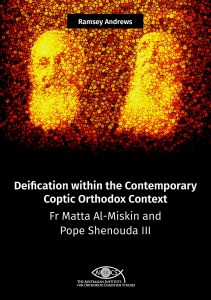
The book is available for purchase in PDF format.
In 2008, in the postscript of Coptic Christology in Practice, Stephen J. Davis observed:
“While it is unclear how this (deification) debate will resolve itself in future generations, its impact on the theology and common life of the church in Egypt will undoubtedly be profound. At stake is nothing less than the cultural legacy of biblical and patristic interpretation” (Stephen J. Davis, Coptic Christology in Practice: Incarnation and Divine Participation in Late Antique and Medieval Egypt (New York: Oxford University Press, 2008), 278).
It is precisely this task, of clarifying the assumptions at play in the debate over theosis, deification, and finding a way past the controversy, that Ramsey Andrews undertakes in the present essay.
Avoiding any polemical posture, Andrews addresses the notion of deification as discussed by two towering figures of contemporary Coptic Orthodox theology: Pope Shenouda III (1923–2012) and Fr Matta al-Miskīn (1919–2006). In a careful and objective manner, he clarifies their respective stances and then traces the possible influences that shaped their thought. In so doing, Andrews engages directly with what Davis identified as “the cultural legacy of biblical and patristic interpretation” of deification within the historical life of the Church in Egypt.
Andrews begins by offering a concise yet compelling account of the patristic doctrine of deification. While not exhaustive, his treatment focuses primarily on the writings of St Athanasius and St Cyril of Alexandria, early church fathers revered within the Coptic Orthodox Church and beyond. In this way, he establishes the theological foundations for Fr Matta’s explicit adherence to the Alexandrian tradition. Andrews shows how Fr Matta—who operated deliberately within these patristic parameters, as well as against the backdrop of relevant scriptural texts—understood theosis as the ultimate telos of salvation.
 In a similar vein, Andrews’ examination of Pope Shenouda’s conceptualisation of deification begins with an analysis of the Arabisation of the patristic doctrine within the particular context of Muslim Egypt. He persuasively illustrates Pope Shenouda’s reliance on Copto-Arabic theologians’ emphasis on deification as grounded in the incarnation—namely, the union of humanity and divinity in the person of Christ. Andrews highlights the Copto-Arabic affirmation of humanity’s deification in Christ, while also clarifying that the primary focus of these theologians was shaped by the cultural, religious, and philosophical challenges specific to medieval Muslim Egypt.
Throughout the essay, Andrews engages both Fr Matta and Pope Shenouda with intellectual honesty and theological sensitivity. He identifies the respective strengths and limitations of each position, giving particular attention to constructive paths forward. Accordingly, he concludes by proposing a “plurivocal Orthodox framework that welcomes a plurality of theological expressions within Orthodoxy’s bounds,” adding that “unity rather than uniformity and coherence rather than ideological simplifications should serve as a starting point for a dialogue that seeks to achieve harmony in a spirit of love.”
In this respect, Andrews has, in a modest yet meaningful way, responded to Davis’ call to explore the debate on deification within the Coptic Orthodox Church, with the hope of fostering a deeper and more nuanced understanding of a doctrine whose implications remain vital for the life and witness of Coptic Christianity.
AIOCS Press is proud to publish this insightful work as the first of the “Beginnings” series, which promotes promising research by early career academics. For this work, Andrews was awarded the inaugural “Beginnings” prize, in 2024.